
The Verdict
A portfolio tells you what you own. A financial plan tells you whether what you own is enough for what you want to achieve.
A portfolio can perform well and still not be enough to meet a financial goal. A financial plan connects money with goals.
A Portfolio and a Financial Plan Answer Different Questions
Investors naturally focus on portfolio value, returns, mutual funds, stocks, asset allocation and market movements. These are important, but they answer only part of the financial picture.
A financial plan starts with a different question: What are we trying to achieve with the money?
| Portfolio | Financial Plan |
|---|---|
| What investments do I own? | What financial goals do I have? |
| How much is my portfolio worth? | How much will each goal require? |
| What return am I earning? | What return is reasonably required? |
| What is my asset allocation? | How should my money be allocated across goals? |
| How has the portfolio performed? | Am I financially on track? |
| Focuses mainly on investments | Considers investments, cash flows, liabilities, protection and goals |
The portfolio is a component of the financial plan. It is not the financial plan itself.
Why a Good Portfolio Can Still Be a Poor Plan
Consider a family with a portfolio worth Rs.1 crore. On its own, that number tells us very little.
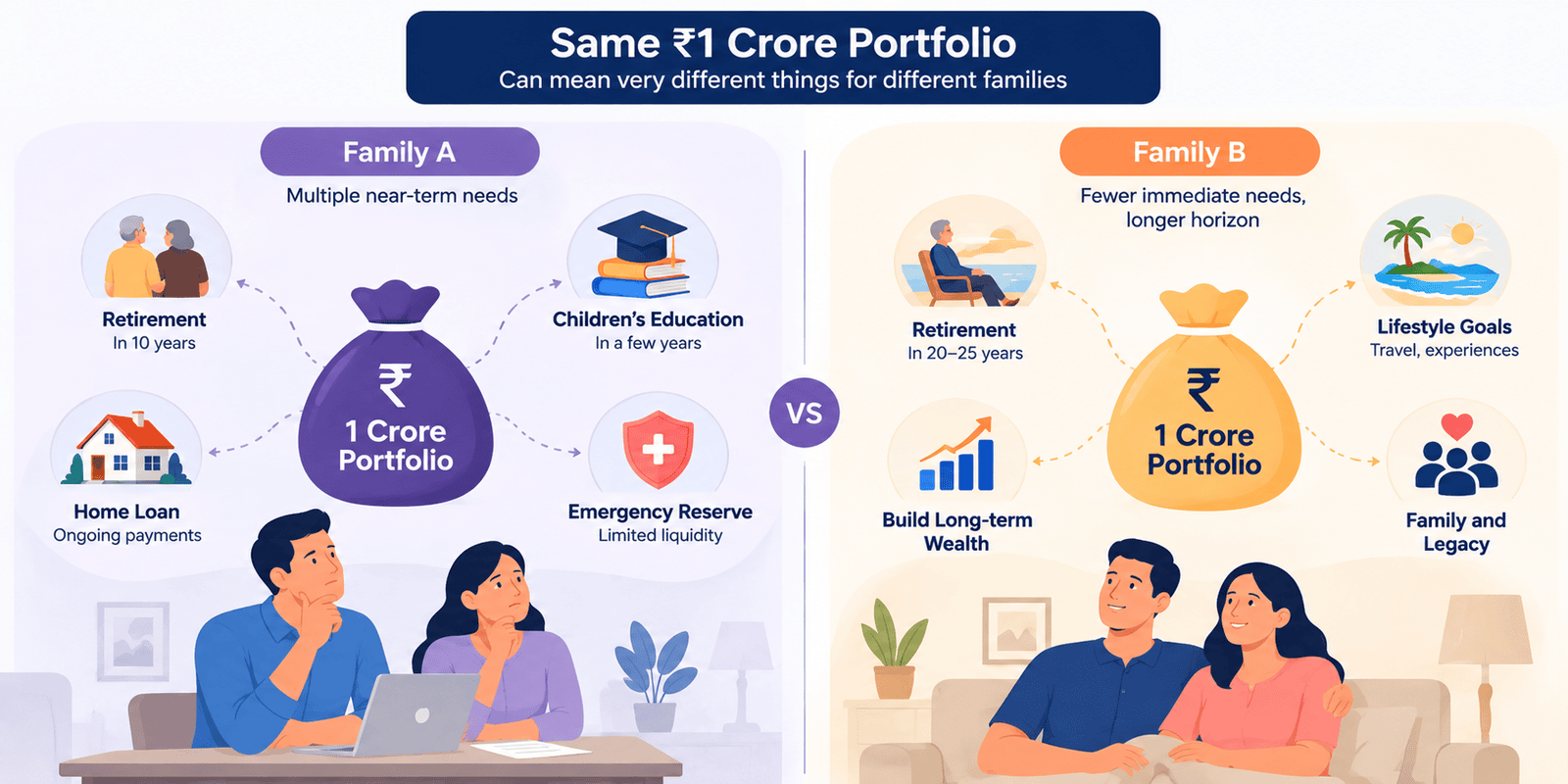
Suppose the family is 10 years away from retirement, has two children's education goals, a home loan, regular household expenses and limited emergency liquidity.
Another family may also have a Rs.1 crore portfolio, but have no major liabilities, no immediate large financial goals and a much longer investment horizon.
The two families have the same portfolio value, but they do not have the same financial situation.
This is why the important question is not simply: “How much do I have?”
The better question is: “What is this money meant to do?”
Start With the Goal, Not the Investment
Once the purpose of the money is clear, the next step is to understand when it will be needed, how much may be required and how much financial uncertainty the family can reasonably absorb.
Take retirement as an example. If someone plans to retire at age 55, the investment decision cannot be separated from questions such as:
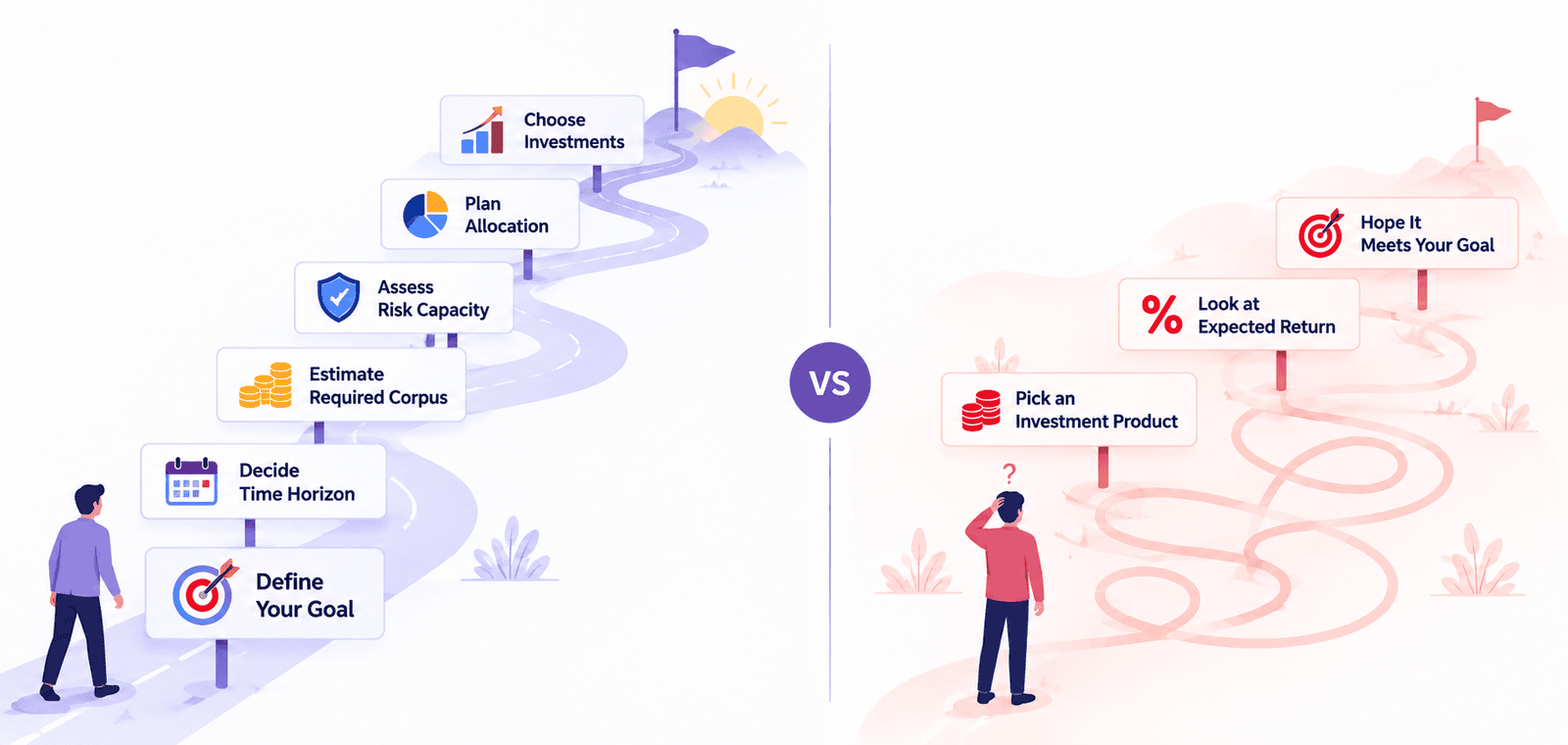
- How many years are left until retirement?
- What level of annual spending will be required?
- How might those expenses change over time?
- Will there be other sources of income?
- What assets and investments already exist?
- Are there other financial goals competing for the same money?
- How much volatility can the financial situation reasonably absorb?
Only after understanding these factors does the portfolio become meaningful.
Returns Are Important – But They Are Not the Objective
Returns matter. They help money grow and are an important part of long-term financial planning.
But returns are a means, not the ultimate objective.
A portfolio generating a higher return than another portfolio is not automatically better for every investor. The right assessment depends on:
Goal + Time + Risk + Liquidity + Cash Flow
A near-term goal may require greater emphasis on protecting the money that will soon be needed. A long-term goal may be able to tolerate greater fluctuations.
One Person Can Have Several Different Financial Needs
Consider a family with:
- Retirement — 15 years away
- Child's higher education — 6 years away
- Emergency reserve — needed immediately
- Home loan — an ongoing liability
These needs have different time horizons, liquidity requirements, risk considerations and consequences.
Think in Terms of “Money With a Job”
Instead of looking only at the total portfolio value, ask:
“What job does each part of my money need to perform?”
Some money may have the job of providing an emergency reserve. Some may have the job of funding education. Some may have the job of creating retirement income. Other money may be allocated towards long-term goals.
What Should You Review Besides Returns?
A meaningful financial review should look beyond investment performance. Five areas deserve attention.
- Goals
Have your goals changed because of marriage, children, career changes, property decisions, retirement plans or lifestyle changes? - Cash Flow
What are your current income, expenses and savings? Is the surplus sufficient for your future requirements? - Liabilities
A growing portfolio does not automatically mean your financial position has improved if liabilities have also increased. - Protection
What happens to the financial plan if an important source of income stops unexpectedly? - Investments
Only after understanding the above should investments be evaluated for their suitability to the objectives, time horizon and risk profile.
A Simple Financial Planning Check
A useful review can begin with five straightforward questions:
- Where am I today? Assets, liabilities, income, expenses and existing investments.
- Where do I want to go? Retirement, education, property, lifestyle and other financial goals.
- When will I need the money? Different goals require different time horizons.
- Am I on track? Compare the resources available with the future requirements.
- What needs to change? Adjust savings, allocation, goals or other financial decisions where necessary.
Succinct Verdict
A rising portfolio value is encouraging. A strong return is useful. Neither automatically means the financial plan is working.
The real measure is whether your financial resources are moving closer to the goals they are meant to fund.
A portfolio is a collection of investments. A financial plan is the framework that gives those investments purpose.
So, don't ask only: “How much has my portfolio grown?”
Also ask: “Given where I am today, my future cash flows and my financial goals, am I on track?”
This article is for educational purposes only and should not be construed as investment advice or a recommendation to buy or sell any security or investment product.