
Markets will fall. The real question is not whether the next fall will happen, but whether we will allow it to change a financial plan that was built for the long term.
Every market fall feels different when you are living through it. The headlines become louder, portfolio values move sharply, and the natural instinct is to ask: Should I do something? Should I sell? Should I wait for the market to recover?
But history gives us a different perspective. Indian equity markets have experienced several major falls over the last two decades — some deep, some sudden, and some surprisingly short-lived. The market has fallen sharply during individual years and yet, in some cases, still finished those years with positive returns. Recovery periods have also varied widely. There is no fixed timetable for a market recovery.
This is why long-term investing is less about predicting the next market move and more about having a financial plan that can withstand uncertainty. Before reacting to a market fall, the more important question is: Has something changed in your financial goal, time horizon, cash-flow needs or ability to take risk — or has only the market changed?
This article looks at what the history of Indian equity markets can teach us about market falls, recovery periods, investment horizons and, most importantly, why staying connected to the purpose of your money can be more important than reacting to the emotion of the moment.
THE LONG VIEW
A market fall is a reason to review — not automatically a reason to retreat.
When the Market Falls, What Should an Investor Do?
When markets fall sharply, the first reaction is often to look at the portfolio. A better starting point is to look at the financial plan.
A market correction does not automatically mean that the investment strategy is wrong. The important question is whether anything fundamental has changed — the goal, the time horizon, the need for liquidity, the expected cash flows, or the investor's ability to tolerate risk.
If the financial objective remains the same, reacting purely to a temporary change in market prices can sometimes move an investor away from the strategy that was designed to achieve that objective.
Before changing the investment plan, ask: “Has my financial situation changed — or has only the market changed?”
Markets Have Fallen Many Times Before
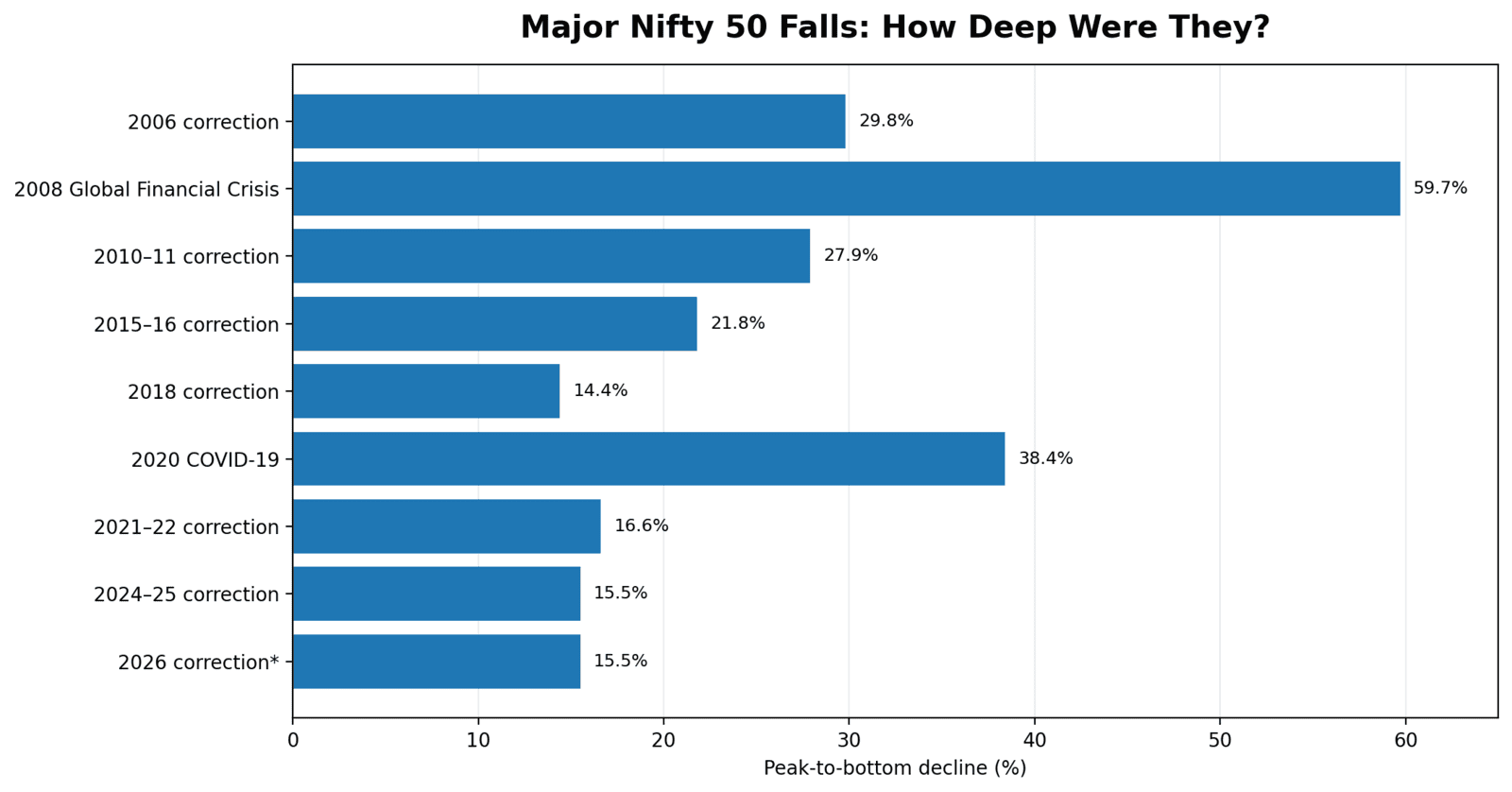
Over the last two decades, Indian equity markets have experienced several significant corrections. They have differed in size, speed and recovery time — which is important because there is no single pattern that tells us how the next market fall will behave.
The table below looks at some of the major market declines and shows two things investors often want to know during a correction: how far the market fell and how long it took to recover its previous peak.
The lesson is not that every fall will recover quickly. The lesson is that recovery has never followed a fixed timetable.
| Episode | Peak | Bottom | Fall | Previous peak regained | Recovery period* |
|---|---|---|---|---|---|
| 2006 correction | May 2006 | Jun 2006 | -29.8% | Oct 2006 | 5 months |
| Global Financial Crisis | Jan 2008 | Oct 2008 | -59.7% | Nov 2010 | 34 months |
| 2010–11 correction | Nov 2010 | Dec 2011 | -27.9% | Nov 2013 | 36 months |
| 2015–16 correction | Mar 2015 | Feb 2016 | -21.8% | Sep 2016 | 18 months |
| 2018 correction | Aug 2018 | Oct 2018 | -14.4% | Apr 2019 | 8 months |
| COVID-19 crash | Jan 2020 | Mar 2020 | -38.4% | Nov 2020 | 10 months |
| 2021–22 correction | Oct 2021 | Jun 2022 | -16.6% | Nov 2022 | 13 months |
| 2024–25 correction | Sep 2024 | Mar 2025 | -15.5% | Oct 2025 | 13 months |
| 2026 correction* | Jan 2026 | Mar 2026 | -15.5% | Not yet | Ongoing* |
A Fall Is Not the Same Thing as a Failed Year
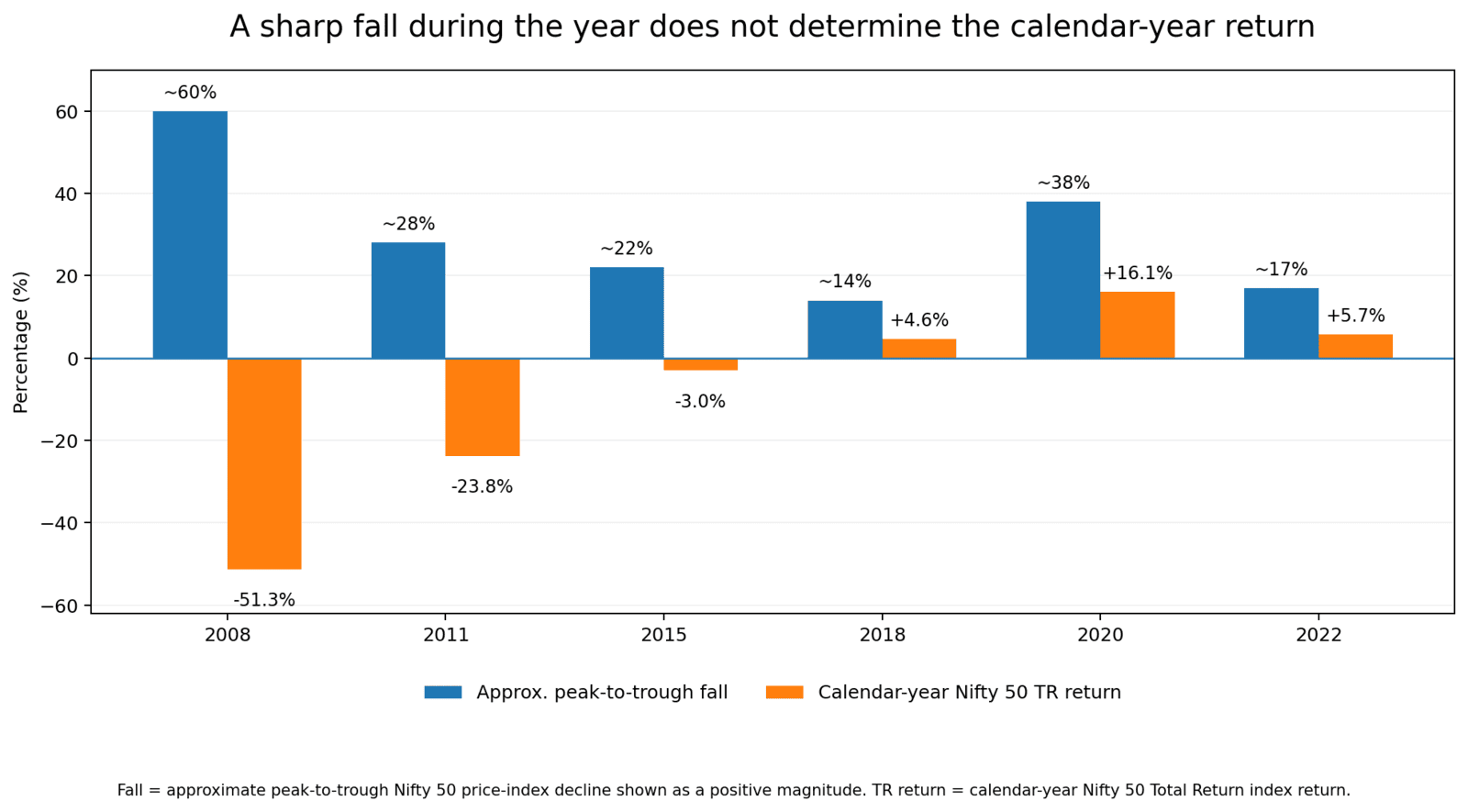
One of the most important lessons from market history is that a sharp fall during the year does not necessarily mean that the year will end badly.
2020 is a particularly useful example. During the COVID-19 shock, the Nifty 50 fell by roughly 38% from its January peak to its March low. For investors watching their portfolios during those weeks, the experience was understandably unsettling.
Yet the market did not remain at that low. The recovery was remarkably rapid, and the Nifty 50 ended 2020 with a positive calendar-year return.
THE IMPORTANT DISTINCTION
The worst point an investor experiences during a year is not necessarily where the year ends.
This distinction matters because investors often evaluate a long-term investment strategy using a very short-term snapshot. A portfolio may be significantly below its recent high at one point in time and still be on track to deliver a satisfactory long-term outcome.
This does not mean every market fall will recover quickly, or that losses should be ignored. It means that the path of returns can be very different from the final outcome.
For someone investing for a financial goal several years away, the more relevant question is therefore not simply, “How much has the market fallen?” but also, “How much time do I have, and does my financial plan still support the goal?”
What Does “Rolling Return” Actually Mean?
When investors look at market returns, they often focus on calendar-year numbers: what happened in 2020, 2021 or 2022. But a financial goal rarely starts on January 1 and ends on December 31.
Rolling returns look at every possible investment period of a particular length. For example, a 5-year rolling return asks: If an investor had invested on any day in the historical period and stayed invested for the next five years, what annualised return would they have experienced?
This gives a broader picture than simply looking at individual calendar years. It helps us understand how different starting points can affect the experience of an investor — particularly when markets are volatile.
The important point is that longer investment periods can reduce the influence of any single market event, although they do not eliminate investment risk or guarantee positive returns.
The longer the financial goal, the less useful a single market snapshot becomes.
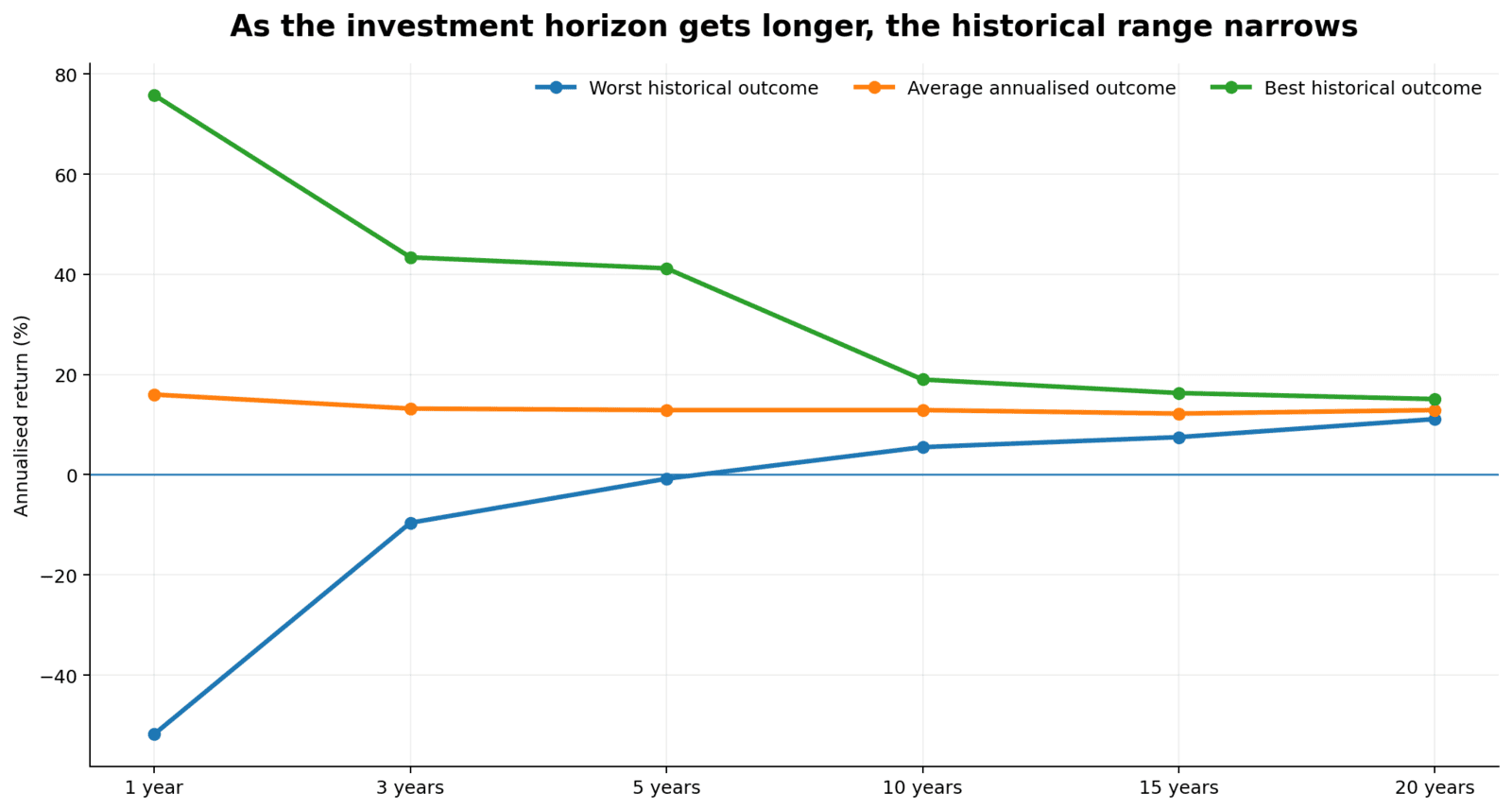
Historical Nifty 50 price-return observations across rolling investment periods. Returns are annualised and represent historical outcomes, not forecasts or guarantees. The figures exclude dividends, taxes, costs and inflation.
Two Major Falls. Two Very Different Recoveries
Not all market falls behave in the same way.
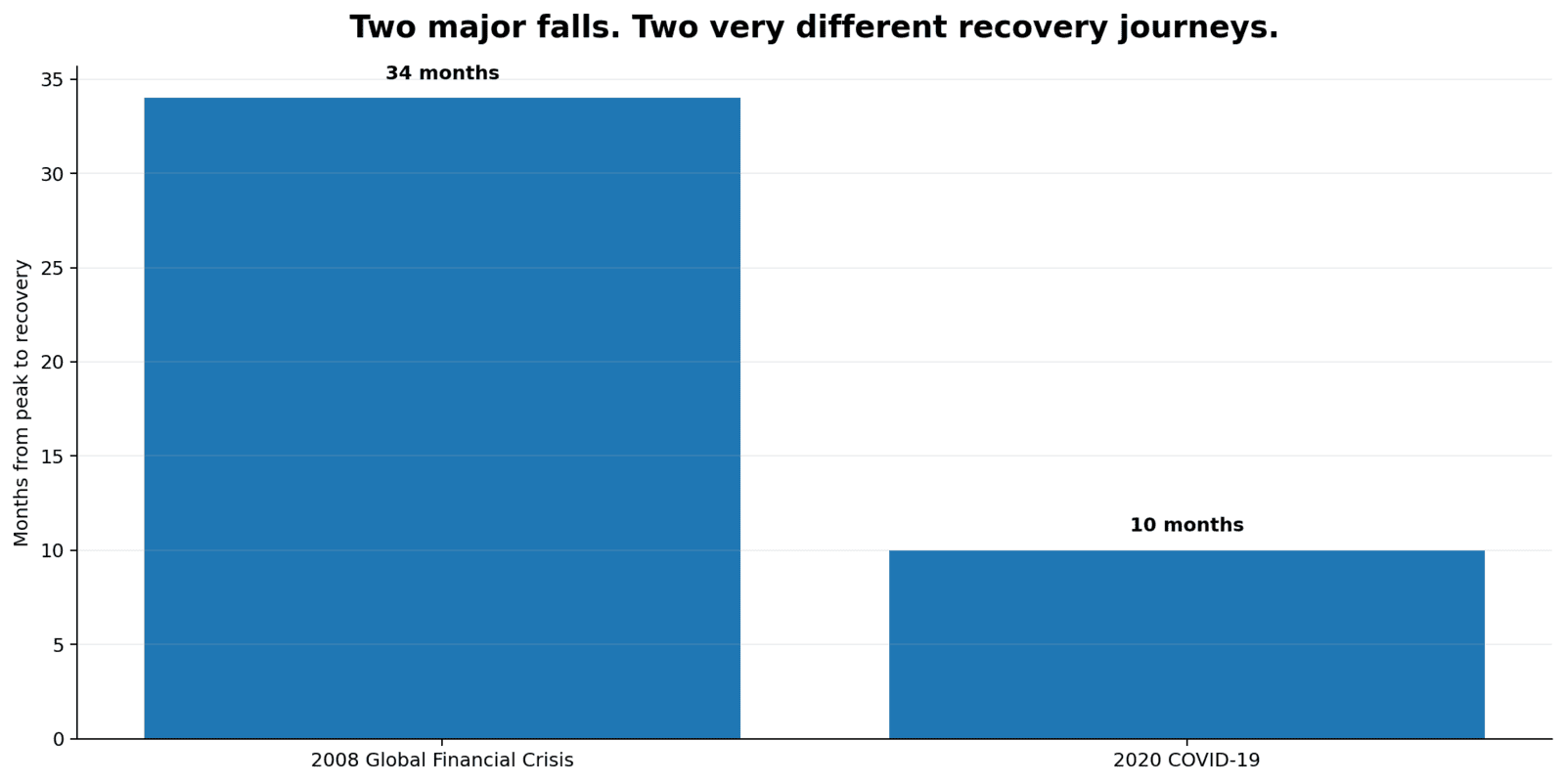
The Global Financial Crisis of 2008 and the COVID-19 crash of 2020 are useful examples. Both produced severe declines, but the speed and duration of the subsequent recovery were very different.
In 2008, the Nifty 50 fell by roughly 60% from its peak to its low. The recovery to the previous peak took much longer.
In 2020, the market fell by roughly 38% in a matter of weeks. Yet the recovery was considerably faster, with the previous peak regained within the same year.
There is no reliable timetable for when the next market fall will recover.
This is why trying to predict the exact bottom or the exact recovery date is generally a difficult foundation for a financial plan. A better approach is to build the plan around the investor's time horizon, cash-flow requirements, liquidity needs and ability to take risk.
The Financial Plan Has a Different Clock
A market moves every day. A financial goal usually does not.
A retirement goal may be 10, 15 or 20 years away. A child's education goal may have a defined future date. A portfolio created for these objectives should therefore be evaluated against the time available to achieve the goal, not simply against what the market has done over the last few weeks or months.
This is where financial planning becomes different from simply investing.
A market correction tells us what prices are doing today. A financial plan asks a different question: Does the current portfolio still have a reasonable path towards the future objective?
If the goal, time horizon, cash-flow requirements and risk capacity have not materially changed, a market decline by itself may not justify abandoning the original strategy.
THE FINANCIAL PLAN TEST
Before making a decision during a market fall, step back and ask:
- Has the goal changed? Is the amount required or the purpose of the money different?
- Has the time horizon changed? Is the money now needed significantly earlier than originally planned?
- Has the cash-flow requirement changed? Will withdrawals or liquidity needs arise sooner than expected?
- Has the ability to take risk changed? Has your financial situation changed enough that the existing level of market exposure is no longer appropriate?
- Or has only the market changed? If the financial plan is still fundamentally intact, reacting only to market prices deserves careful thought.
What Should an Investor Focus on During a Correction?
A market correction can create a lot of information — but not all of it is useful for making a financial decision.
Instead of trying to predict the next market move, focus on the factors that are actually within the financial plan.
1. The purpose of the money
Money invested for a long-term goal should be assessed against that goal, not against the latest market headline.
2. The time available
A portfolio with a long investment horizon has more time to absorb periods of market volatility than money that will be needed shortly.
3. Liquidity needs
Money required for near-term expenses should not depend on an uncertain market recovery.
4. Asset allocation
A correction is an appropriate time to check whether the portfolio's asset allocation still matches the investor's objectives, risk capacity and time horizon.
5. Behaviour
One of the most difficult parts of investing is making a long-term decision while experiencing a short-term loss. A written financial plan can provide an important reference point when emotions are strongest.
The objective is not to predict every fall. It is to build a financial plan that does not require perfect prediction.
Patience Is Not Doing Nothing
Patience in investing is sometimes misunderstood as simply sitting still and ignoring what is happening.
It is not.
Good investing requires ongoing review. The difference is between reviewing a portfolio against the financial plan and reacting to every movement in the market.
During a correction, patience may mean:
- continuing investments that are consistent with the financial plan;
- rebalancing when the planned asset allocation requires it;
- ensuring sufficient liquidity for near-term needs;
- reviewing whether goals, time horizons or risk capacity have changed; and
- avoiding decisions based purely on fear, headlines or recent market performance.
In other words, patience is an active discipline.
It does not mean assuming that markets will always recover quickly. It means recognising that the timing of a recovery is uncertain and that financial decisions should therefore be based on what can actually be assessed and controlled.
The goal is not to be fearless when markets fall. The goal is to have a plan strong enough to make fear a poor decision-maker.
Final Verdict: Patience Is a Financial Decision
Market falls are uncomfortable. There is no reason to pretend otherwise. But history also shows why reacting to every fall can be a poor substitute for having a financial plan. The Nifty 50 has experienced sharp corrections, prolonged declines and unusually fast recoveries. Some falls have taken years to recover from; others have recovered within months.
There is no reliable timetable for the next recovery.
That uncertainty is precisely why trying to predict the bottom is generally a difficult foundation for long-term financial planning.
The more useful question is not:
“When will the market recover?”
It is:
“Given my goals, time horizon, cash-flow requirements and ability to take risk, does my financial plan still make sense?”
If the answer is yes, patience may be one of the most valuable decisions an investor can make.
Not because markets always go up.
Not because every fall will recover quickly.
But because a long-term financial plan should be designed around the life the money needs to fund — not around the market's next move.
THE BOTTOM LINE
Markets will fall.
Recovery will be uncertain.
Your financial plan should be built with that uncertainty in mind.
For investors, the objective is not to avoid every period of discomfort. It is to make thoughtful decisions when discomfort is highest — and to keep those decisions connected to the purpose of the money.
Sources & Methodology
The historical market observations and charts in this article are based on historical Nifty 50 index data and published NSE market information. Peak-to-trough declines and recovery periods are approximate and can vary slightly depending on whether intraday or closing levels are used and how recovery is defined.
Rolling-return observations represent historical Nifty 50 price-return outcomes across different investment periods. Returns are annualised and are intended to illustrate the range of historical outcomes, not to forecast future returns.
Historical returns do not guarantee future performance. Investment outcomes can be affected by asset allocation, costs, taxes, inflation, timing of cash flows and individual circumstances.
This article is for educational and informational purposes only and should not be construed as investment advice or a recommendation to buy or sell any security.